
the evasid
Books
Why I Write
I began by writing my memoirs—an attempt to confront a life that had been lived in fragments and disguises.
In the process, I discovered that memory alone is not enough. It records events, but it does not always reveal their meaning.
From that realisation, my writing changed. The same experiences—of flight, reinvention, and consequence—became the material for fiction.
In novels and short stories, I could explore not only what happened, but what lies beneath it.
What began as reflection became creation.
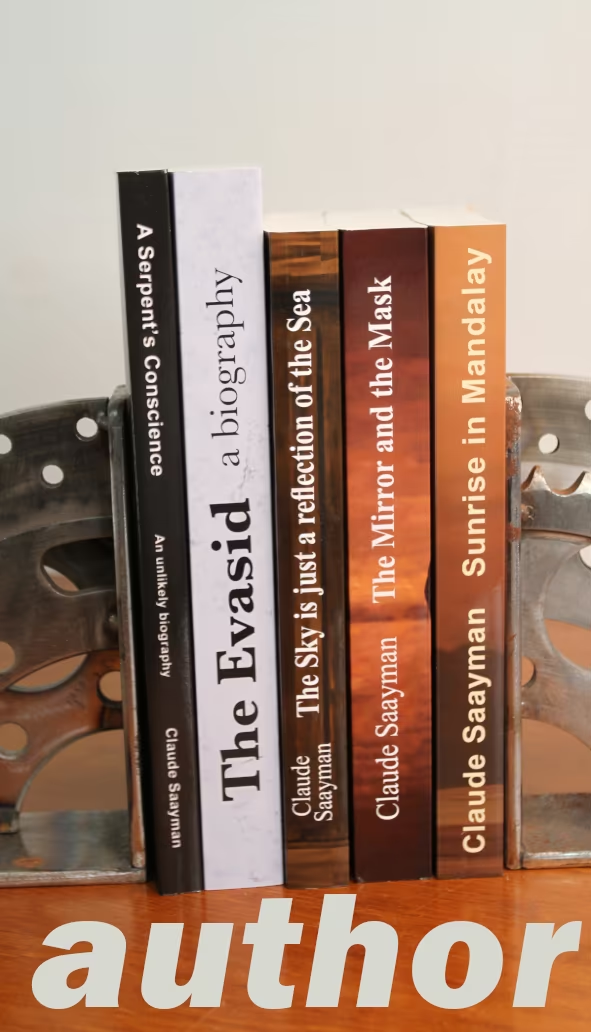



the sky is just a reflection of the sea
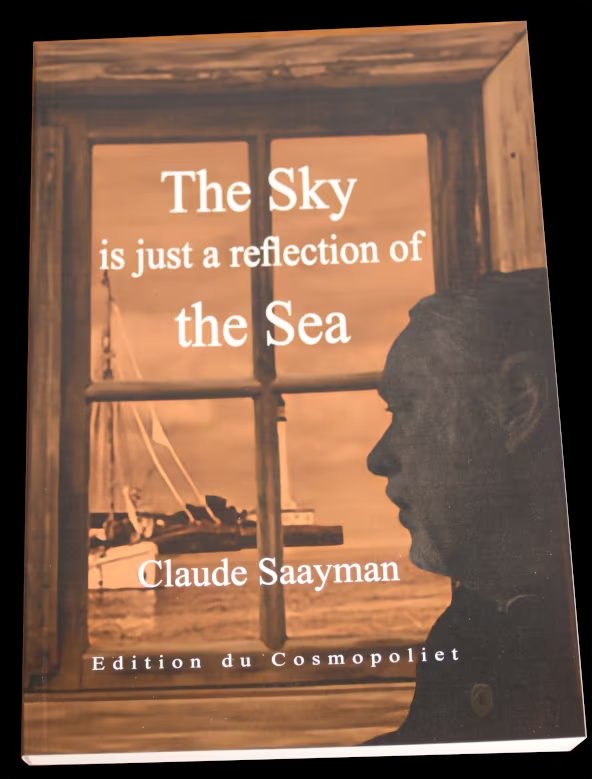
Marc grows up in rural South Africa in the late 1960s, emotionally adrift in a fractured family. His father drinks, his mother withdraws, and Marc learns early to escape through adrenaline—motorbikes, risk, and eventually the exhilaration of flight.
He steals a private plane and later an Air Force jet—a crime that carries the death penalty. He deserts, seeks intensity through danger, and increasingly through drugs. His life spirals into episodic highs and devastating crashes.
Attempting to repair familial ties, Marc lives for a time with his father and stepmother in Durban. The household becomes strained as suspicion and addiction erode trust. Marc’s psychological collapse escalates. His father eventually commits him to psychiatric care, and he is sent to a rehabilitation centre. Though he initially cooperates, Marc is ostracised by other residents and twice attempts suicide. Therapy reveals deep emotional wounds but cannot address the core disorder driving his self-destructive patterns.
After leaving rehab, Marc drifts back into Johannesburg’s criminal underworld—drugs, stolen cars, impulsive theft.
He meets Lorraine, a young artist whose compassion temporarily steadies him. Their relationship becomes the closest thing he has known to real affection, but Marc’s compulsions and criminal behaviour soon lead to his arrest and imprisonment.
He attempts a daring escape from the Old Fort prison. He succeeds in scaling the walls but is captured under gunfire.
Returned to detention and placed in “the box,” his mental and physical state worsen.
Marc is incarcerated in solitary confinement at Pretoria Central Prison. Inside, he witnesses brutality, exploitation, and the daily proximity of the gallows. His mind deteriorates under solitary confinement. He hallucinates André, a violent inmate who attempted to assault him in the showers and whom Marc may have killed in self-defence. The ambiguity of that moment haunts him. He endures months of delusion, and despair.
He watches condemned prisoners sing their final hymns on the way to execution and imagines his own name called among theirs.
Years pass in solitary confinement, eroding Marc’s sense of reality. Through a series of interior “flights”—the last of which becomes a symbolic reckoning—Marc confronts the roots of his hunger: the absence of love, the terror of identity, and the longing to belong to something larger than himself.
Eventually, the Air Force summons him to court-martial. Marc manages to slip away from his guard in the mess hall. For the first time in years, the internal hunger that defined his life falls quiet. He realises that escape—whether through drugs, crime, or flight—has never been freedom. It has only been postponement.
The memoir closes in a small harbour room where Marc prepares to flee the country with a stolen passport. Though technically free, he remains haunted by the past. The passport represents both possibility and exile. The judgement he faces is not legal but moral: whether he can confront who he has been and step into a future without running.
Marc closes the passport and prepares for dawn, unsure of what awaits him, but carrying—for the first time—a fragile willingness to meet it.
the mirror and the mask

This book follows the narrator's life after his escape from prison.
The successful escape marks not a resolution, but a continuation of the central pattern: movement as survival.
Using a stolen passport, the protagonist flees to Europe. In Frankfurt, he experiences a moment of exhilaration, interpreting his anonymity as rebirth. However, this sense of renewal is revealed to be illusory. His life becomes a series of transient identities, each constructed to navigate new environments. He moves across Switzerland, Italy, and Greece, surviving through deception, improvisation, and adaptability. Encounters with danger—including narrowly escaping a terrorist bombing—reinforce both his sense of invincibility and the randomness of survival.
Throughout this period, the act of reinvention becomes more deliberate. He recognises that identity is not inherent, but performed and validated by others. This insight leads to a more structured form of imposture.
In Israel, he attempts to establish stability. Initially drawn to the promise of communal life, he is instead directed into a more controlled environment where his technical skills can be utilised. Here, the interplay between external structure and internal instability becomes more pronounced. He constructs a new identity as a medical student, despite lacking formal qualifications. Immersing himself in study, he learns to replicate the language, behaviour, and authority associated with the role. Over time, the performance becomes convincing—not only to others, but to himself. This marks a critical shift: imposture evolves from a survival mechanism into a foundational identity. The boundary between authenticity and performance dissolves.
During this period, he forms significant relationships, including a romantic involvement that offers the possibility of emotional grounding. However, these relationships are built upon deception. His need for validation and fear of exposure prevent genuine intimacy.
The revelation of past consequences—particularly the suicide of a former partner—introduces a profound sense of guilt. Rather than prompting change, this reinforces his reliance on constructed identities as a means of coping. The pattern becomes cyclical: success through deception, followed by instability, collapse, and renewed reinvention.
As the protagonist moves through various roles and environments—expanding beyond medicine into other professional identities—his capacity for imposture leads to increasing success. He assumes positions of responsibility and authority, often exceeding his actual qualifications. Externally, his life appears to stabilise. Internally, the fragmentation deepens. Each new identity requires sustained performance. The effort to maintain these constructions creates cumulative psychological strain. Relationships fail, trust erodes, and the gap between appearance and reality widens.
The turning point comes not through exposure or failure, but through success. Having achieved financial stability and professional recognition, he confronts an unexpected emptiness. The identities he has constructed cannot provide coherence or meaning. He withdraws from this life and retreats to the margins.
Near the sea, he undertakes the physical restoration of a derelict steel boat. This process, grounded in tangible labour and material reality, contrasts sharply with the constructed nature of his previous existence. The work becomes a form of discipline and reflection. Encouraged by others, he begins to write.
What begins as a therapeutic exercise evolves into a structured examination of his life. Writing forces him to confront the consequences of his actions—not only the external outcomes, but the internal patterns that shaped them. In particular, he reflects on the impact of his choices on those closest to him, including his children.
The act of writing becomes an alternative to escape. Instead of moving forward, he remains—revisiting, analysing, and attempting to understand.
The memoir concludes not with redemption, but with acceptance. The protagonist does not resolve his past or reclaim a fixed identity. Instead, he relinquishes the need for reinvention. In doing so, he arrives at a quieter form of freedom: the ability to inhabit his own life without disguise.
the evasid

This book is a condensed version of “The sky is just a reflection of the Sea” and “TheMirror and The Mask”.
The story is essentially the same but omits the narrator’s childhood.
It was written as a basis for a film script, a documentary or a television series.
The book can be read as a stand-alone work.
It has also been translated into French.
Sunrise in Mandalay

Sunrise in Mandalay is a literary novel set along the maritime and bureaucratic fault lines of Southeast Asia, where humanitarian idealism, insurgent violence, and state power intersect not in drama but in procedure.
Marco Raphaeli, an ageing Italian skipper, runs a wooden schooner, Jemsai, carrying medical supplies into western Myanmar under the auspices of a Western aid programme. The work appears clean, even redemptive. Clinics are built, lives are saved, and paperwork flows smoothly between Washington, Rangoon, and the river ports of the Kaladan delta.
But alongside the medicine moves something else. Arms are hidden within aid shipments, justified as protection for vulnerable clinics and tolerated as long as no one is forced to acknowledge them. Marco understands more than he admits. Chuck Parker, the American coordinator, understands less than he believes. Between them lies a structure designed to function without moral clarity.
The system begins to fail not through exposure but through error. A minor clerical mistake in Rangoon quietly transforms a tentative naval observation into official certainty: Jemsai is now classified as an insurgent supply vessel.
Lieutenant Commander Myo Maung, a methodical naval officer whose family’s financial empire underwrites the aid operation itself, becomes determined to erase the threat before it implicates his name.
When Jemsai is fired upon during a monsoon night, the violence is brief and chaotic. Officially, the vessel is destroyed. Myo is commended. Medals are prepared. In reality, the ship survives, salvaged by insurgents and hidden in the jungle.
Truth and record diverge cleanly and permanently. What follows is not retribution but administrative collapse. The Maung family is stripped of control and honour through audits, cancellations, and silence. The insurgents retreat inward, executing one of their own to preserve internal coherence. Chuck returns to Washington celebrated publicly and discarded privately, left to live with a reputation built on a lie he can neither dismantle nor confess.
Marco, confronted with the execution carried out to protect his ship, seeks revenge. He is stopped only when Cho, Jemsai’s translator and quiet intermediary, reveals the insurgent commander is her brother. Marco lowers the gun—not in forgiveness, but in refusal. Violence, he recognises, would merely complete the symmetry.
The novel closes with Jemsai leaving Myanmar at first light. Nothing is resolved. No one is redeemed. The ship sails on carrying the residue of survival, proof that in modern conflicts, morality is rarely defeated—it is simply managed.
The Runway

The Runway opens not with ambition but with absence: a federal aviation inquiry into the collapse of a small regional airline whose director has quietly relocated. No charges are laid. The file remains open.
Months later, at a modest airport in southern Ontario, David Mercer presides over routine and stability. When Adrian Keller arrives with a proposal to build a maintenance hangar on underused land, the project seems plausible—practical even.
Mercer sees in Keller a version of the expansive leadership he once aspired to. The town’s weary mayor sees tax revenue. The Provincial Minister sees regional resilience. Claire, his communications strategist, sees narrative opportunity.
Only BenGallagher, a high school English teacher who writes for the local paper, hesitates. He senses thinness in Keller’s background but misjudges the scale of what is forming.
As the project gathers momentum—through feasibility studies, political acceleration, and quiet land consolidation—illusion becomes shared. Each participant projects his or her desire onto the runway.
While public attention fixes on Keller, the real leverage shifts upward. Rezoning multiplies land value. An offshore structure binds federal ambition to private gain. No one feels criminal; each feels justified.
When the discrepancy is finally noticed—not by national media but by Ben’s stubborn arithmetic—the structure does not explode. It reveals itself.
The land is returned. A minister is convicted. Reputations thin.
Keller has already moved on.
The runway remains as it was: long enough to suggest possibility, short enough to imposelimits.
The novel explores how ambition becomes illusion, how language shapes reality, and how clarity arrives only after projection collapses under its own weight.
The Irony of Infidelity
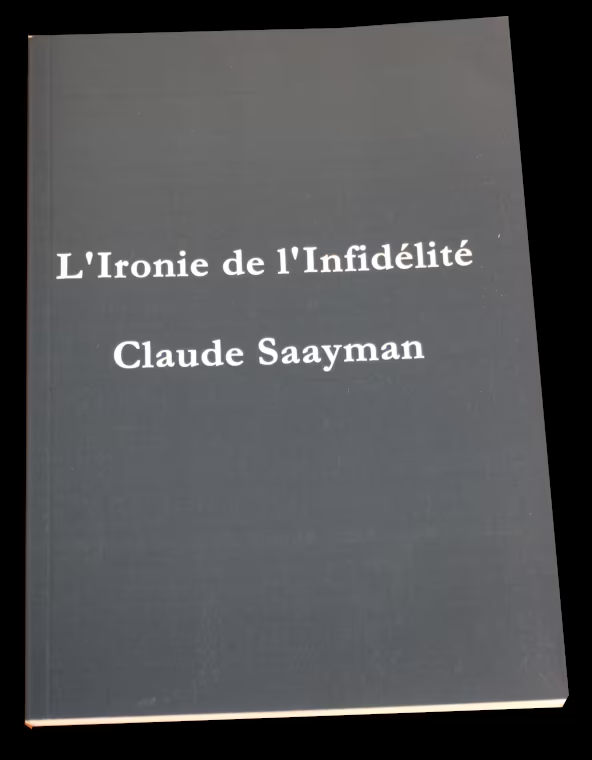
The Irony of the Affair is a first-person literary novel narrated by a man late in life who has withdrawn from public ambition to live alone on a boat.
From this narrowed existence, he begins an unsparing moral reckoning with the patterns that have shaped his life: serial affairs, emotional evasion, and a persistent refusal to choose.
The novel opens with an unexpected reconnection with Olga, a woman he once loved and never fully released. Their renewed contact—initially through correspondence, later through discreet meetings—does not ignite passion so much as expose what has long been avoided. Unlike the women who preceded her, Olga does not flatter, demand, or rescue. She waits, sees, and refuses illusion. Prompted by this encounter, the narrator revisits the archive of his affairs: women who reflected versions of himself he was willing to accept—admired, needed, obeyed, forgiven.
Each relationship is examined not sentimentally, but as evidence of a deeper pattern rooted in self-deception, fear of authority, and a lifelong confusion between admiration and love. As the relationship with Olga deepens, the novel shifts from recollection to confrontation. The narrator learns to remain rather than escape, to endure ambiguity rather than manipulate outcome.
He returns fully to the boat, which becomes not a refuge but a boundary, and faces the moral cost of his restraint—particularly toward the two wives who lived beside a man emotionally absent yet structurally reliable. In a pivotal confession, he offers Olga not promises or plans, but truth: a full acknowledgment of his evasions and his unwillingness to choose.
She does not absolve him, nor does she reject him. She simply sees him, and allows him the dignity of consequence.
The novel concludes not with resolution but acceptance. The narrator recognises that love does not rewrite lives or repair damage; it clarifies vision. Olga represents the moment when he becomes capable of love—precisely when its fulfilment is impossible. What remains is a quieterf idelity: to truth, to limits, and to a self no longer sustained by disguise. The Irony of the Affair is a novel about self-recognition rather than redemption, and about love not as escape, but as an imperfect mirror through which one finally learns how to remain.
The book has been translated into French and Russian.
AUTHOR’S NOTE
This novel grew out of an interest not in infidelity itself, but in the moral patterns that sustain it.
I was drawn to the figure of a man who has survived by adaptation—by charm, movement, and delay—and who must confront, late in life, the cost of having preserved possibility at the expense of presence. The book is not an argument about marriage or desire, but an exploration of self-deception, and of the moment when understanding no longer offers protection. The tone owes a debt to the late work of Graham Greene, particularly his restrained moral vision and his interest in characters who are neither redeemed nor condemned, only seen clearly. I was less interested in dramatic resolution than in the quieter discipline of acceptance. The Irony of the Affair is intended as a reflective novel rather than a confessional one.
While its emotional material is intimate, its aim is not exposure but recognition: the slow, difficult process by which a man learns to stop asking love to justify his life.
From this narrowed existence, he begins an unsparing moral reckoning with the patterns that have shaped his life: serial affairs, emotional evasion, and a persistent refusal to choose.
The novel opens with an unexpected reconnection with Olga, a woman he once loved and never fully released. Their renewed contact—initially through correspondence, later through discreet meetings—does not ignite passion so much as expose what has long been avoided. Unlike the women who preceded her, Olga does not flatter, demand, or rescue. She waits, sees, and refuses illusion. Prompted by this encounter, the narrator revisits the archive of his affairs: women who reflected versions of himself he was willing to accept—admired, needed, obeyed, forgiven.
Each relationship is examined not sentimentally, but as evidence of a deeper pattern rooted in self-deception, fear of authority, and a lifelong confusion between admiration and love. As the relationship with Olga deepens, the novel shifts from recollection to confrontation. The narrator learns to remain rather than escape, to endure ambiguity rather than manipulate outcome.
He returns fully to the boat, which becomes not a refuge but a boundary, and faces the moral cost of his restraint—particularly toward the two wives who lived beside a man emotionally absent yet structurally reliable. In a pivotal confession, he offers Olga not promises or plans, but truth: a full acknowledgment of his evasions and his unwillingness to choose.
She does not absolve him, nor does she reject him. She simply sees him, and allows him the dignity of consequence.
The novel concludes not with resolution but acceptance. The narrator recognises that love does not rewrite lives or repair damage; it clarifies vision. Olga represents the moment when he becomes capable of love—precisely when its fulfilment is impossible. What remains is a quieterf idelity: to truth, to limits, and to a self no longer sustained by disguise. The Irony of the Affair is a novel about self-recognition rather than redemption, and about love not as escape, but as an imperfect mirror through which one finally learns how to remain.
The book has been translated into French and Russian.
AUTHOR’S NOTE
This novel grew out of an interest not in infidelity itself, but in the moral patterns that sustain it.
I was drawn to the figure of a man who has survived by adaptation—by charm, movement, and delay—and who must confront, late in life, the cost of having preserved possibility at the expense of presence. The book is not an argument about marriage or desire, but an exploration of self-deception, and of the moment when understanding no longer offers protection. The tone owes a debt to the late work of Graham Greene, particularly his restrained moral vision and his interest in characters who are neither redeemed nor condemned, only seen clearly. I was less interested in dramatic resolution than in the quieter discipline of acceptance. The Irony of the Affair is intended as a reflective novel rather than a confessional one.
While its emotional material is intimate, its aim is not exposure but recognition: the slow, difficult process by which a man learns to stop asking love to justify his life.
reviews

“A rare combination of lived experience and moral clarity, written with restraint and precision. What could have been sensational is rendered with quiet intelligence and remarkable control.”
Kevin R.

“A compelling account of identity and self-invention, told without self-pity orexaggeration. The writing is measured, reflective, and deeply human — it trusts the reader.”
Sarah M.

Success cannot replace the self lost in its pursuit.
impostor
author
artist
fugitive
