
the evasid
My life has taken the shape of a long, uneven road. It began in hardship and led, by degrees, to solitary confinement and the slow anticipation of a death sentence. I escaped.
After that, there was only movement. I crossed borders and learned, quickly, that each country required a different version of me. I obliged. I worked the soil, held a scalpel I had no right to hold, carried a camera through conflict, stood watch as a guard, and built machines as an engineer.
I founded companies—shipyards, high-tech firms, even airlines. I dined with presidents and police chiefs while remaining a wanted man. I was trusted with responsibilities far beyond my qualifications and led projects worth billions.
From the outside, it might have resembled success.
But each identity was provisional. Each role required belief—first from others, and then from myself.
I had no diploma, no fixed centre, only the ability to become what was required and leave before it collapsed.
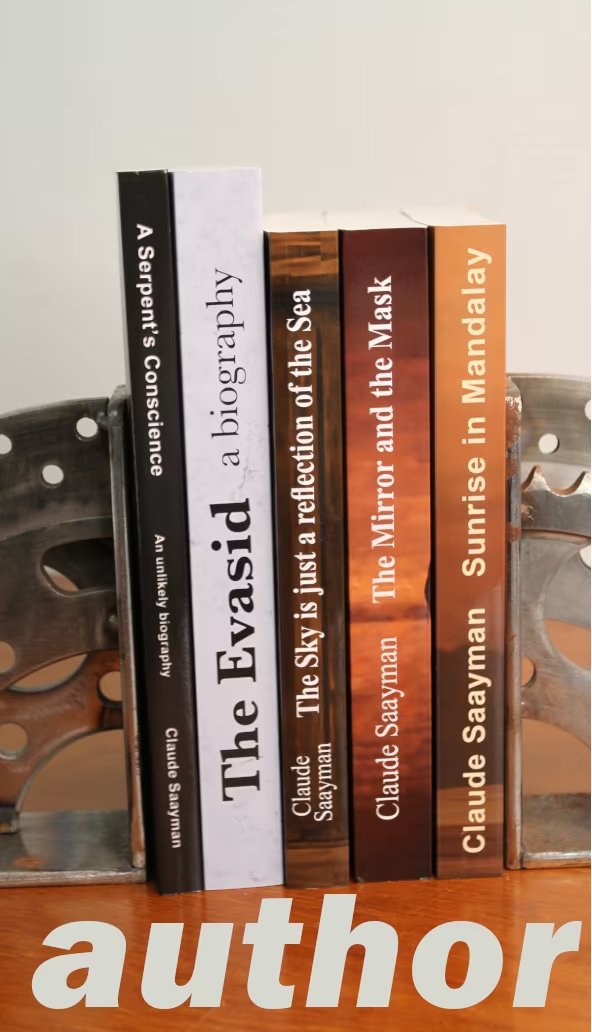



childhood

My earliest memory is of my father standing at a kitchen sink, shaving in the half-light. I must have been four, perhaps five. He looked at me, almost casually, and said I had a weak chin—that I would have to learn to stand up for myself. It was not said with cruelty, but it stayed with me. I think, from that moment, I began to suspect there was something insufficient in me.
My parents’ marriage was never still. They separated and returned to each other so often that I lost count. The house held a kind of permanent tension—raised voices, slammed doors, then silence. I grew up inside that uncertainty, learning early that nothing settled for long.
For a brief time, I found something like safety with Maybelle, the woman who worked in our home. She carried her baby on her back and moved through the house with a quiet steadiness. She would lift me from my playpen and hold me as if nothing else in the world were in dispute. Sometimes she sang. I did not understand the words, but I remember the feeling of them. It was the first and perhaps the last uncomplicated kindness of my childhood.
It did not last. When my parents separated again, my mother left me with relatives. I remember the feeling—not of being placed somewhere temporarily, but of being given away. That fear stayed. Even when she came back for me, something had already shifted. I had begun to understand that love could disappear without warning.
At school, the world did not soften. The nuns ruled through humiliation. A slap from the Mother Superior taught me that authority could be both righteous and violent. The other boys kept their distance, and when I tried to force my way in—by stealing a football, by lying—I was punished again. It became clear to me that weakness invited correction, and that there was little mercy in it.
By seven, I had learned what it was to be singled out. A boy named John made it his habit to remind me of my place. One afternoon, after a beating, I stood in the schoolyard in wet shorts while the others laughed. Something hardened in me then—not courage, but a kind of resolve.
A few days later, I found myself alone with something that belonged to him—a white rabbit he kept at the school. I cannot fully explain what happened next, only that I wanted, for once, not to be the one who was powerless. What I did marked a change. I crossed a line I did not yet have words for, but I recognised, even then, that I had stepped beyond something I could not return to.
Later, on my grandparents’ farm, I discovered a different kind of refuge. The land was wide and indifferent. There was no comfort in it, but there was clarity. I spent time alone, drawn to things that frightened me—snakes, dark places, the edge of danger. Fear steadied me. It demanded focus. In those moments, I felt something close to control.
When my grandmother once dismissed me as a “filthy swine” after I came home covered in mud, I decided to leave. My younger brother and I hitchhiked across the country, believing, in the simple way of children, that we could go somewhere better. We did not get far, but the idea stayed with me: that movement itself could be a kind of answer.
At boarding school, that instinct deepened. I was told I would love it. I did not. It was a place of quiet loneliness, where escape became less an idea and more a necessity. I tried, in small and foolish ways, to find a way out—none of them worked. Eventually, I ran. I packed what I thought I would need and walked into the mountains. I lasted only a short time before exhaustion forced me back. Even then, I understood something I could not yet articulate—that running did not resolve anything. It only delayed it.
When I look back now, I can see the shape of that boy more clearly than I could at the time. He was not simply unhappy; he was learning, piece by piece, to detach—to rely on himself in ways that would later become both strength and flaw. What I took then for resilience was, in part, a quiet withdrawal from the world.
I did not lose my sense of right and wrong all at once. It shifted gradually, under pressure—through fear, humiliation, and the need to protect myself. By the time I left childhood behind, something essential had already been altered.
I did not yet know where that would lead. But I had begun to understand one thing: when things became too difficult, I would run. And, for a long time, it felt like the only solution I had.
adolesence
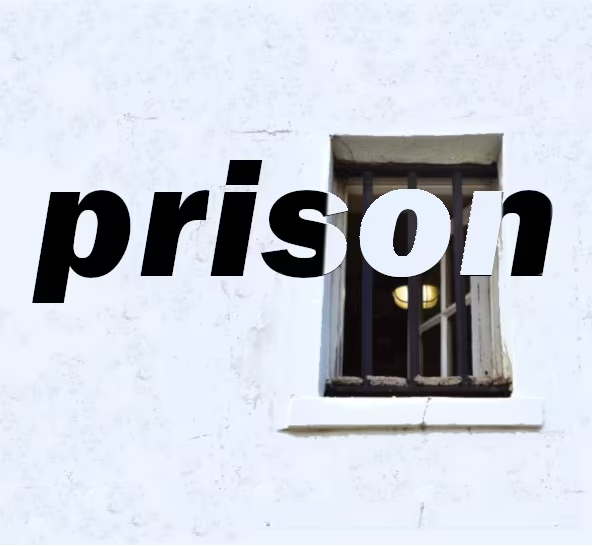
Adolescence did not bring direction. It removed what little structure remained.
I drifted into a life defined by avoidance—drugs, the streets, anything that created distance between myself and whatever surfaced when I was still. There was no clear ambition. Only a need to escape the weight of being myself. Flight became more than fascination. It became a solution.
I stole aircraft during those years—not for gain, but for the experience of leaving the ground behind.
In the air, everything simplified. There was no past, no expectation, no voice demanding that I account for myself. There was only motion, control, and the illusion—brief but convincing—that I was free.
That pattern led me into the Air Force. It seemed, at the time, like a structure that might contain what I could not manage alone. For a while, it worked. Discipline, routine, hierarchy—they gave shape to something that had been formless. But what was unstable in me did not yield to structure. It adapted to it. I began to fracture within that system. I deserted, returned, and deserted again. The same impulses persisted—risk, intensity, escape. The Air Force gave me proximity to aircraft, and with that came temptation. The boundary between duty and transgression dissolved. The theft of aircraft became inevitable.
What followed was not a single collapse, but a sequence of them. Addiction deepened. Judgment eroded. I moved between brief attempts at stability and rapid descent. I betrayed trust where it was offered. I destroyed what might have steadied me. Not out of intention, but because I had no mechanism to sustain anything that required consistency.
My arrest was not a turning point. It was a consequence catching up with a pattern. Prison stripped life down to its essentials—survival, hierarchy, violence. But I did not submit to it. Not at first. I attempted to escape. The attempt was desperate but calculated. For a brief moment, it worked. I cleared the boundary that defined my confinement. I experienced that familiar sensation again—the shift from containment to possibility. It did not last. I was captured and returned.
The consequences were severe. Whatever tolerance the system had was removed. I was placed into deeper confinement—what we called “the box.” It was there that the real descent began. Solitary confinement is not simply isolation. It is the removal of all external structure. Time dissolves. The distinction between day and night weakens. The mind, deprived of reference, begins to turn inward with increasing intensity.
At first, I resisted it. Then I endured it. Eventually, I became subject to it. There were periods when I believed I would be executed. Whether formally sentenced or not became secondary to the environment itself. Men disappeared. Doors opened and did not open again. The sounds of movement in the corridor carried meaning you could not ignore. Death was not theoretical. It was procedural. Under those conditions, the mind adapts in ways that are difficult to explain. I began to hallucinate—not suddenly, but gradually. Conversations formed where there was no one. Figures from my past returned. Authority figures, people I had wronged, people who had wronged me. Even God entered into those conversations—not as certainty, but as argument. The isolation strips away distraction. What remains is whatever you have avoided.
Guilt does not disappear in that environment. It intensifies. Memory becomes immediate. There is no distance from it. Time lost meaning. Survival reduced itself to smaller units—the next hour, the next stretch of silence, the next moment where the mind did not turn against itself completely. At some point, the idea of freedom changed. I no longer thought of leaving the prison. I thought only of relief—from the constant presence of thought, of hunger, of self-awareness. The need to escape the world was replaced by the need to escape myself.
Something in me gave way—not dramatically, but quietly. And yet, I did not die. Years passed in that state. Not as a progression, but as erosion. What remained was not the person who had entered, but something reduced—functional, aware, but stripped of any stable identity. There was no longer a clear sense of who I was, only a continuation of experience.
It was from that condition that the second escape emerged. This time, it was not driven by impulse alone. It carried something else—clarity, or perhaps simply the absence of anything left to lose. I understood the consequences. I understood the likelihood of failure. But I also understood that remaining would lead to a different kind of ending. When I eventually escaped, it was not a moment of triumph. It was a transition. I did not leave that world behind. I carried it with me—intact, unresolved, and inseparable from whatever I would become.
adult

When I eventually escaped, I did not feel free.
I stood in an airport with a stolen passport in my hand, aware that the distance between survival and death had narrowed to a few quiet exchanges across a counter. I had spent years learning how not to be seen, and now I had to become visible again—just enough to pass, but not enough to be questioned.
When the passport was stamped and returned to me, nothing happened. No alarm. No hesitation. Just a small gesture and a polite sentence.
Freedom, I discovered, arrives without ceremony.
I left the country without a name that belonged to me, without a past I could acknowledge, and without any clear sense of what came next. Movement was all I had. And for a time, it felt sufficient.
In Europe, I experienced something close to exhilaration. In Frankfurt, I walked the streets as if I had shed my former life entirely. No one knew me. No one was looking for me. The absence of recognition felt like possibility. But that feeling was not new. I had known it before, in smaller forms—each time my childhood had shifted, each time I had been forced to adapt. I had always learned quickly how to become someone else. What I mistook for rebirth was something else. It was repetition.
I moved across borders—Switzerland, Italy, Greece—constructing temporary versions of myself as circumstances required. I learned how to answer questions without answering them, how to appear certain when I was not, how to exist in the narrow space between suspicion and belief. There were moments when survival felt like luck. I left places hours before disaster arrived. I passed through checkpoints that should have stopped me. I began to believe, quietly, that I could outpace consequence. But each escape came at a cost. With every new beginning, something of substance was lost. I became lighter, more adaptable—but also more hollow. I was no longer building a life. I was assembling one.
By the time I reached Israel, I believed I had found direction. The structure appealed to me—work, routine, purpose. For a brief period, I allowed myself to believe that I could belong to something that did not require reinvention. But even there, the pattern followed. I was guided—subtly—into a role where I could be useful. My past did not need to be explained; it only needed to be redirected. I worked, I studied, I adapted. Outwardly, I became part of a system. Inwardly, nothing had resolved.
It was there that I began to understand something fundamental. Identity is not granted.
It is accepted. If you can perform it convincingly enough, the world will confirm it for you.
I had left school early. I had no qualifications. But I began to construct a new version of myself—a medical student. At first, it was approximation. I learned the language, the posture, the confidence required. I studied obsessively, not out of discipline, but out of necessity.
Over time, the performance became convincing. Patients trusted me. Colleagues accepted me. Authority followed—not because it was formally earned, but because it was assumed. I held the scalpel.
What began as deception evolved into competence. And competence, in turn, became difficult to distinguish from legitimacy. That is how imposture takes hold. It does not begin as ambition.
It begins as survival. But once established, it becomes something else entirely. I carried that pattern forward.
From medicine into other roles, other professions, other identities. Each one built on the same foundation: observation, adaptation, performance. Each one more convincing than the last. Externally, my life began to stabilise. I held positions of responsibility. I managed projects. I accumulated success in forms that the world recognises—status, income, authority.
Internally, the opposite was happening. Each identity required maintenance. Each role demanded consistency. The distance between who I was and who I appeared to be became increasingly difficult to sustain.
Relationships formed within those identities, but they were never entirely real. Trust requires a fixed point, and I had none.
There were moments when something close to connection emerged—when I believed, briefly, that I could remain. But those moments were always compromised by the same underlying truth: everything rested on something untrue.
The consequences of my earlier life did not disappear. They resurfaced in ways I could not control—through memory, through guilt, through the realisation that the past does not remain contained. It travels with you, quietly, waiting.
The turning point did not come through failure. It came through success.
Having achieved what I believed would resolve something in me, I found instead that nothing had changed. Recognition had replaced identity, but it could not sustain it. I was surrounded by the appearance of a life, but I could not fully inhabit it. I had spent years escaping confinement.
Now I found myself confined by what I had built.
So I left. Not dramatically. Not as an act of courage. Simply as a continuation of the same instinct that had shaped my life from the beginning. When something became too complex to sustain, I moved on.
But this time, something was different. I did not move toward another identity.
I moved away from them. I withdrew to the margins, near the sea, and began rebuilding a derelict steel boat. The work was slow, physical, and exacting. Steel does not respond to performance. It demands precision. It either holds or it fails. For the first time in many years, I was engaged in something that could not be improvised.
It was during this period that I began to write. At first, it was not writing in any formal sense. It was an attempt to understand—to examine the life I had lived without the option of leaving it behind. I was not trying to justify anything. I was trying to see it clearly. Writing imposed a discipline I had avoided for most of my life. It required me to remain.
To revisit moments I would have preferred to leave unresolved. To confront not only what I had done, but the patterns that had led me there. To acknowledge the consequences—not in abstraction, but in their effect on others.
In particular, I came to understand the cost borne by those closest to me. My children had lived within the instability I created. What I had understood as survival had, for them, been something else entirely. That realisation did not offer resolution.
But it removed any possibility of denial.
Over time, the act of writing changed. What began as a form of necessity became something more deliberate. I began to recognise that the boundary between memory and meaning is not fixed. That experience, on its own, does not explain itself. It must be shaped, examined, and, in some sense, interpreted.
From that, fiction emerged. Not as an escape, but as an extension of the same process. A way of exploring the underlying truths of a life without being limited to its literal form. The same themes remained—identity, deception, survival—but they could be examined from different angles, with greater clarity. I had spent most of my life running.
Writing was the first time I stopped.
I do not write to reinvent myself.
I have done enough of that.
I write to remain—long enough to understand the life I once tried to outrun.